This is an example of the kind of website every property gets when you list exclusively with Expat Properties | CR.

La Arboleda
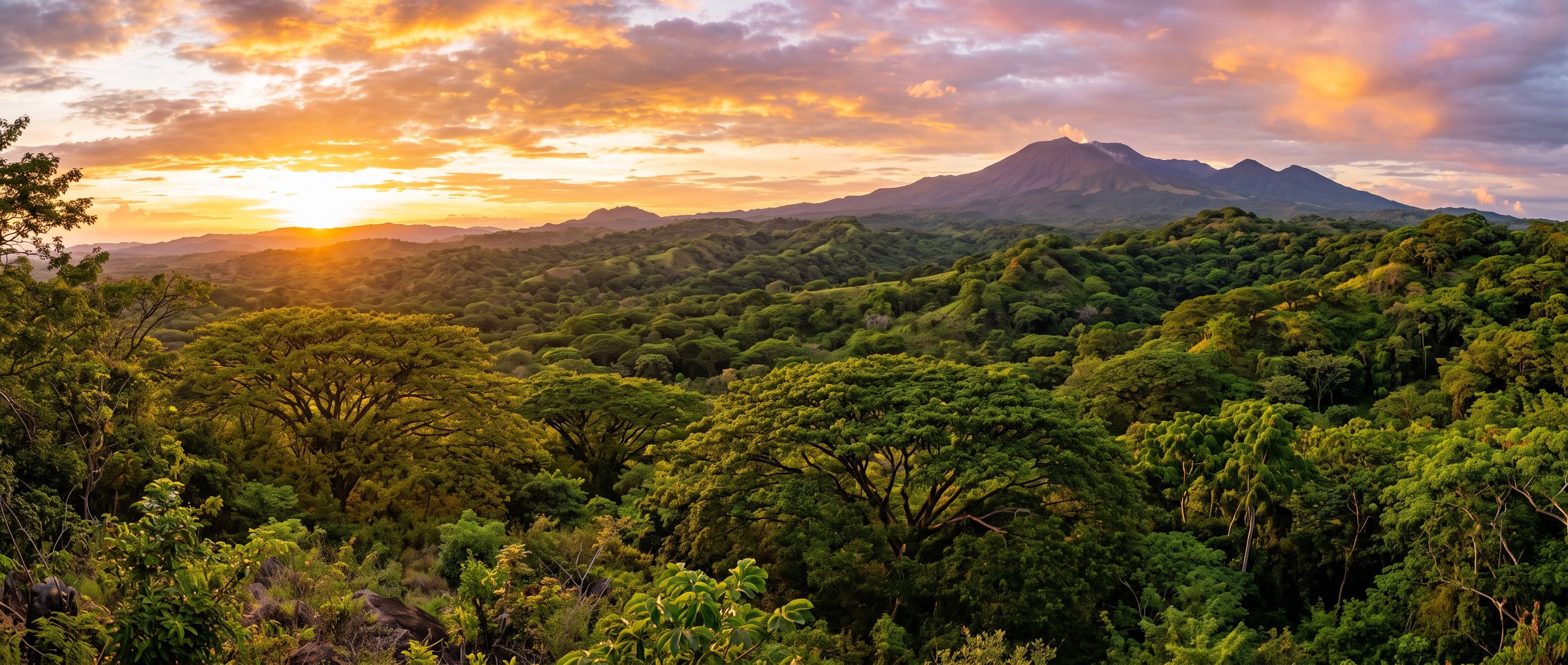
Tropical dry forest canopy of Guanacaste at sunset with a volcano on the horizon
AI concept image of the Guanacaste dry forest. Not a photo of the La Arboleda property.

Curubandé · Liberia · Guanacaste · Costa Rica

Room to grow, in the shade of old trees.

Seventeen private estate lots in the Guanacaste dry forest, each over 5,000 m², joined by a white-gravel road in the old Liberia tradition.

La Arboleda Eco Residencial logo: a broad tree growing over a stone base
Private lots
17
Lot size
5,001 to 6,435 m²
Acres per lot
1.24 to 1.59
Impermeable coverage
Up to 10%

The land

Most of every lot stays forest, garden and open ground.

With impermeable coverage capped at 10%, a home here sits inside its land instead of filling it. The other nine tenths is yours for an orchard, a kitchen garden, a few animals, or simply the trees that were here first.

Specimen · Zygophyllaceae

Guayacán Real

Guaiacum sanctum

One of the hardest, densest woods in the world. It is under a total logging ban in Costa Rica and listed under CITES. It grows only in tropical dry forest, and individual trees can live for centuries.
Specimen · Fabaceae

Cocobolo

Dalbergia retusa

A Pacific dry-forest rosewood prized for its deep red and black grain, now listed as Critically Endangered. Many of them stand on the property.

What this means for owners

Build around them

Protected trees stay. Homes are sited to work with them, which is how the forest keeps its character from lot to lot.

A white road, the old Liberia way

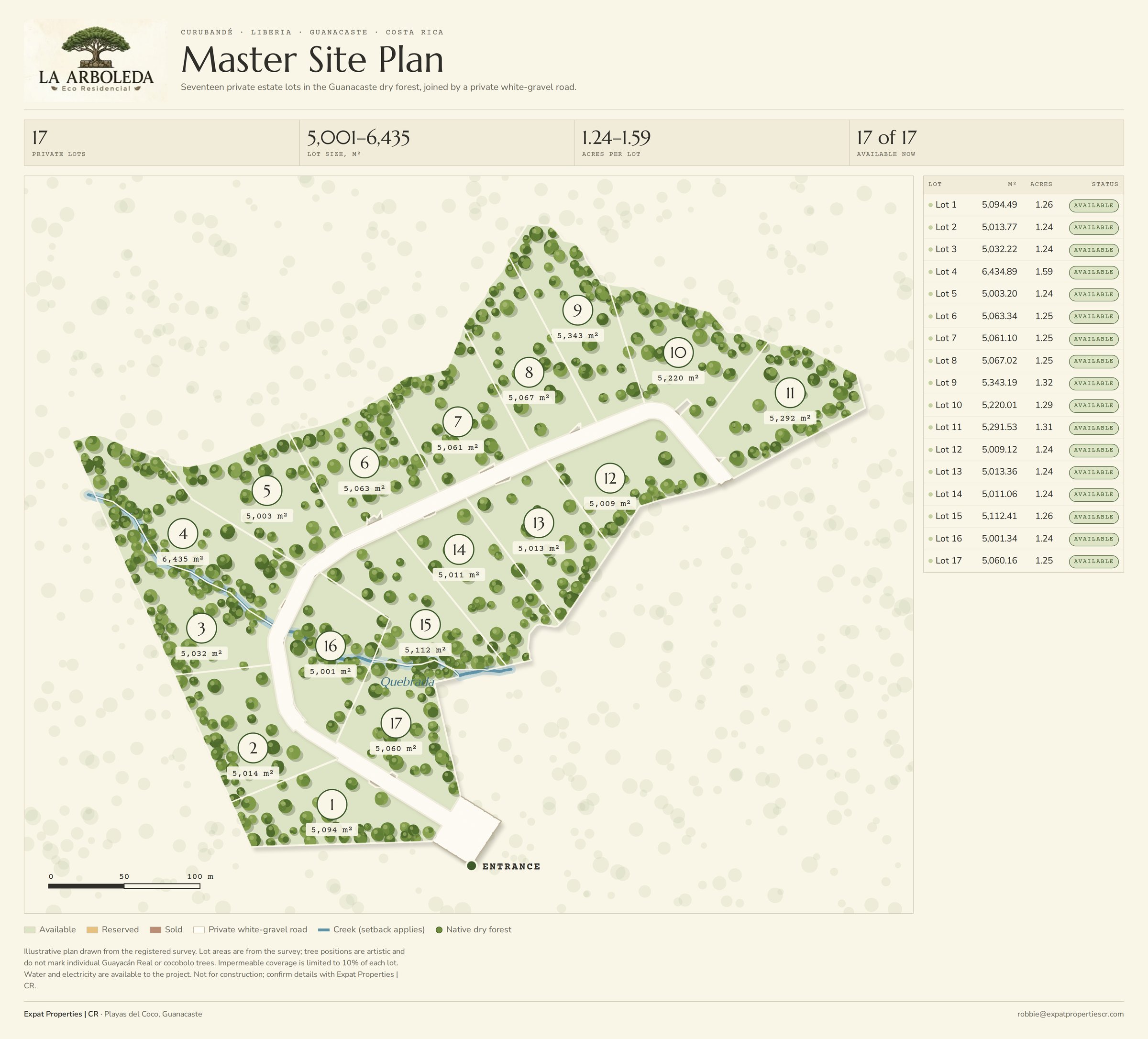
Liberia earned the name La Ciudad Blanca from the white gravel of its early streets and its whitewashed houses. La Arboleda's private road follows that tradition.

Water and electricity

Water and electricity are available to the project, so you start with the essentials in place.

A creek through the forest

A quebrada runs along several lots on the western and southern side of the property. Protection setbacks apply along its banks.

Master site plan

Choose your lot.

Tap any lot to see its size and features. Lot areas are taken from the registered survey.

Two-lot offer Buy two lots and take $10,000 off your second.

Available Reserved Sold Private white-gravel road Creek (setback applies) Native dry forest

Illustrative plan drawn from the registered survey. Tree positions are artistic and do not mark individual Guayacán Real or cocobolo trees. Not for construction. Download the site plan.

What you could build

Six ways to use your 10%.

Impermeable coverage, meaning roofs, pools, patios and paved surfaces, is limited to 10% of each lot, which is about 500 m² on a 5,000 m² lot. These concepts show what fits inside that limit. Gravel drives, garden beds and vineyards stay permeable.

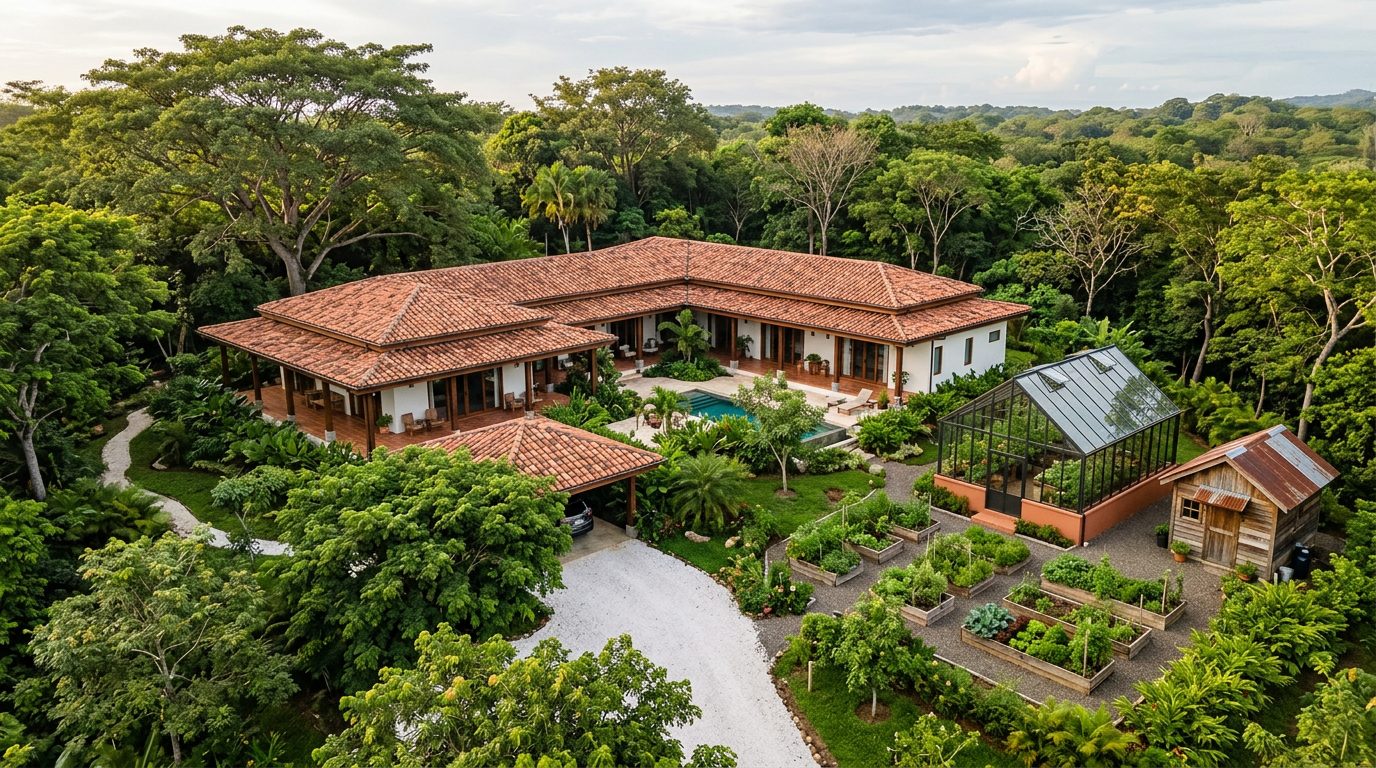
Concept render of a single-story hacienda home with a greenhouse and garden shed in the dry forest

Large family home

The Family Hacienda

A full family home with a serious growing space beside it. Room for four bedrooms, a big kitchen and a greenhouse that keeps the table supplied all year.

  • Family home300 m²
  • Greenhouse160 m²
  • Potting and garden shed40 m²

500 m² of about 500 m² allowed on a 5,000 m² lot

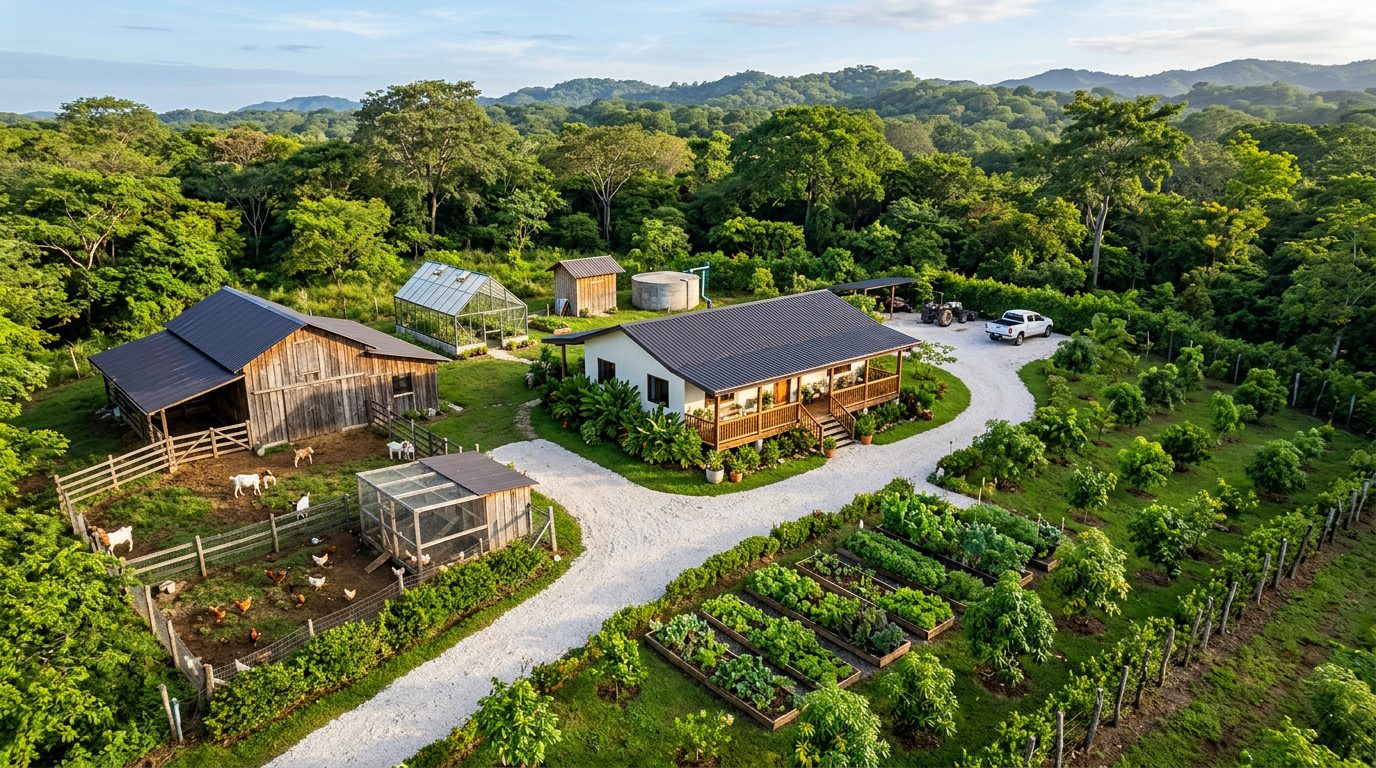
Concept render of a farmhouse, barn, greenhouse and vegetable beds on a forest homestead

Working smallholding

The Homestead Farm

A farmhouse with a barn for goats or chickens, a greenhouse, a tool shed and a rain cistern. Built for people who want to grow and raise their own food.

  • Farmhouse200 m²
  • Greenhouse120 m²
  • Barn and animal shelter100 m²
  • Tool shed30 m²
  • Rain cistern20 m²

470 m² of about 500 m² allowed on a 5,000 m² lot

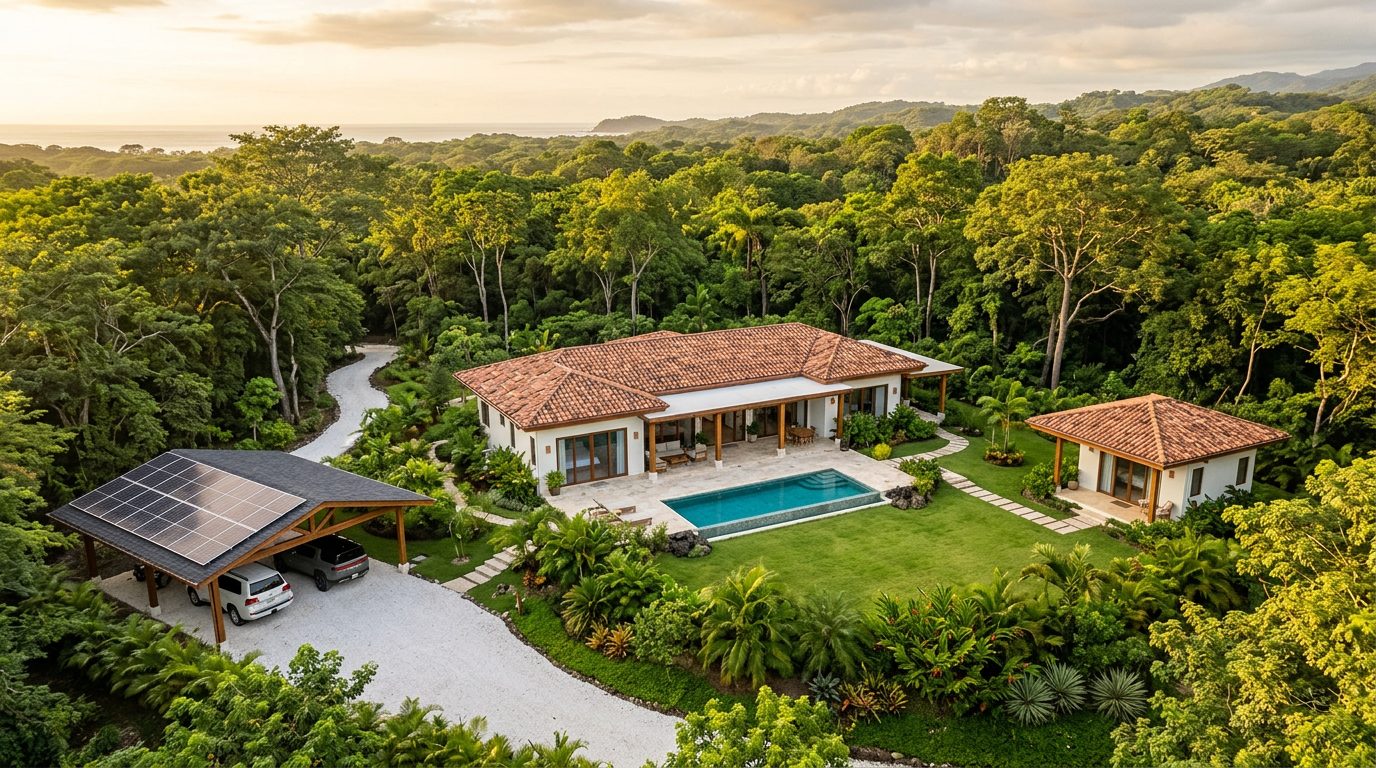
Concept render of a main house with pool, guest casita and solar carport

Multi-generation living

Casa and Casita

A main house and a separate guest casita for family visits, with a pool and a shaded carport. Private space for everyone on one lot.

  • Main house220 m²
  • Guest casita80 m²
  • Pool and deck90 m²
  • Carport60 m²

450 m² of about 500 m² allowed on a 5,000 m² lot

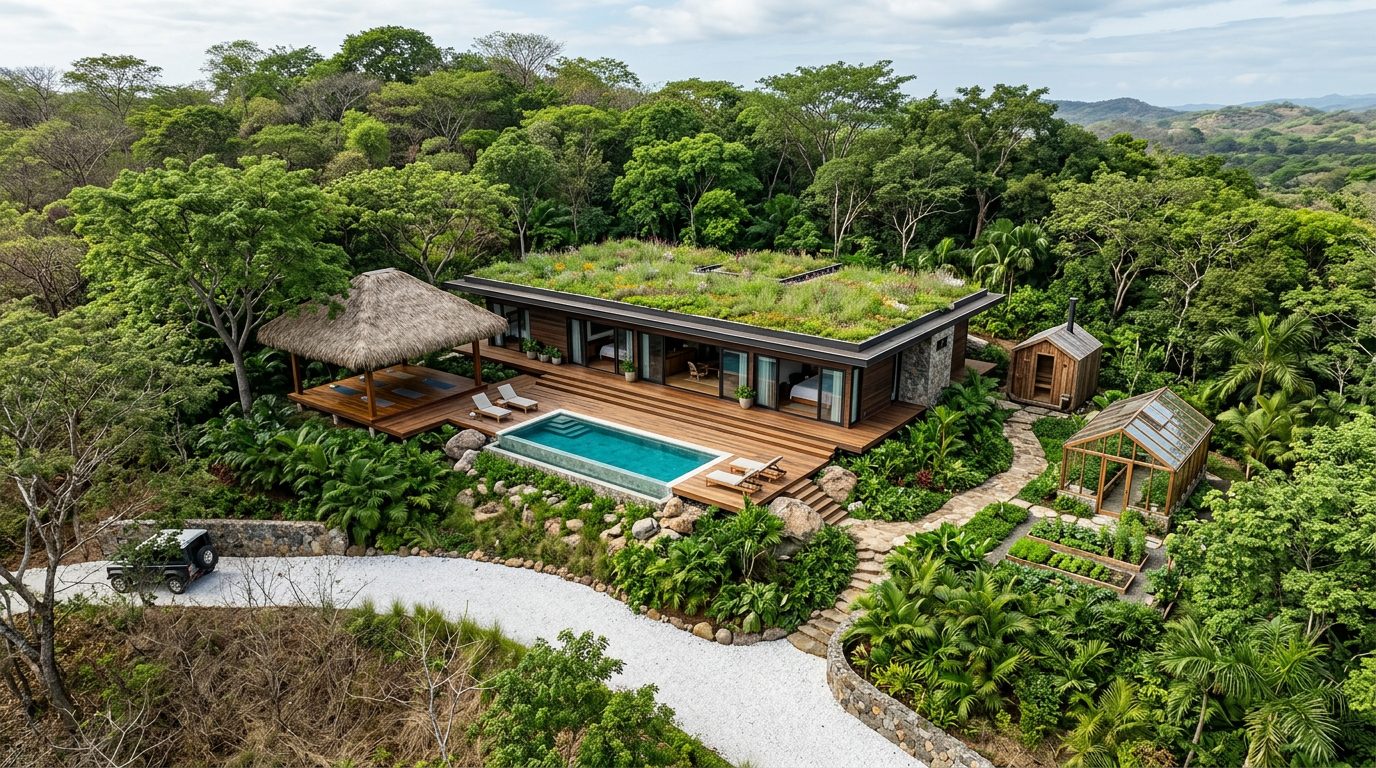
Concept render of a green-roof home with plunge pool, yoga pavilion, sauna and greenhouse

Yoga, pool and garden

The Wellness Retreat

A calm home with an open-air yoga shala in the trees, a plunge pool, an outdoor sauna and a greenhouse for herbs and greens.

  • Home180 m²
  • Greenhouse80 m²
  • Yoga shala60 m²
  • Plunge pool and deck60 m²
  • Outdoor sauna20 m²

400 m² of about 500 m² allowed on a 5,000 m² lot

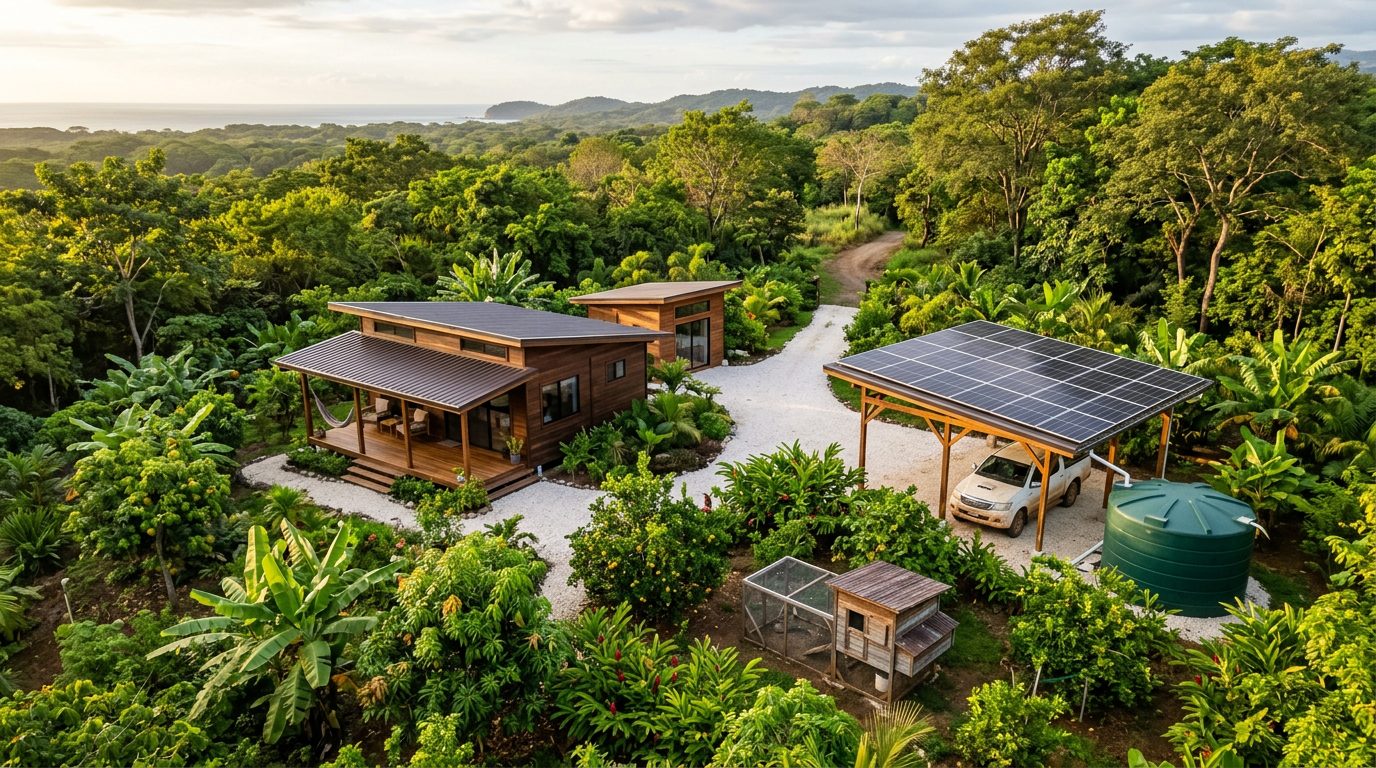
Concept render of a wooden cabin with workshop, solar carport, rain tank and chicken coop in a food forest

Small footprint, big land

Off-Grid Cabin and Food Forest

A compact cabin with a workshop, a solar carport, a rain cistern and a chicken coop. Half the allowed coverage, with the rest of the land given to a food forest.

  • Cabin100 m²
  • Workshop or studio60 m²
  • Solar carport50 m²
  • Rain cistern20 m²
  • Chicken coop20 m²

250 m² of about 500 m² allowed on a 5,000 m² lot

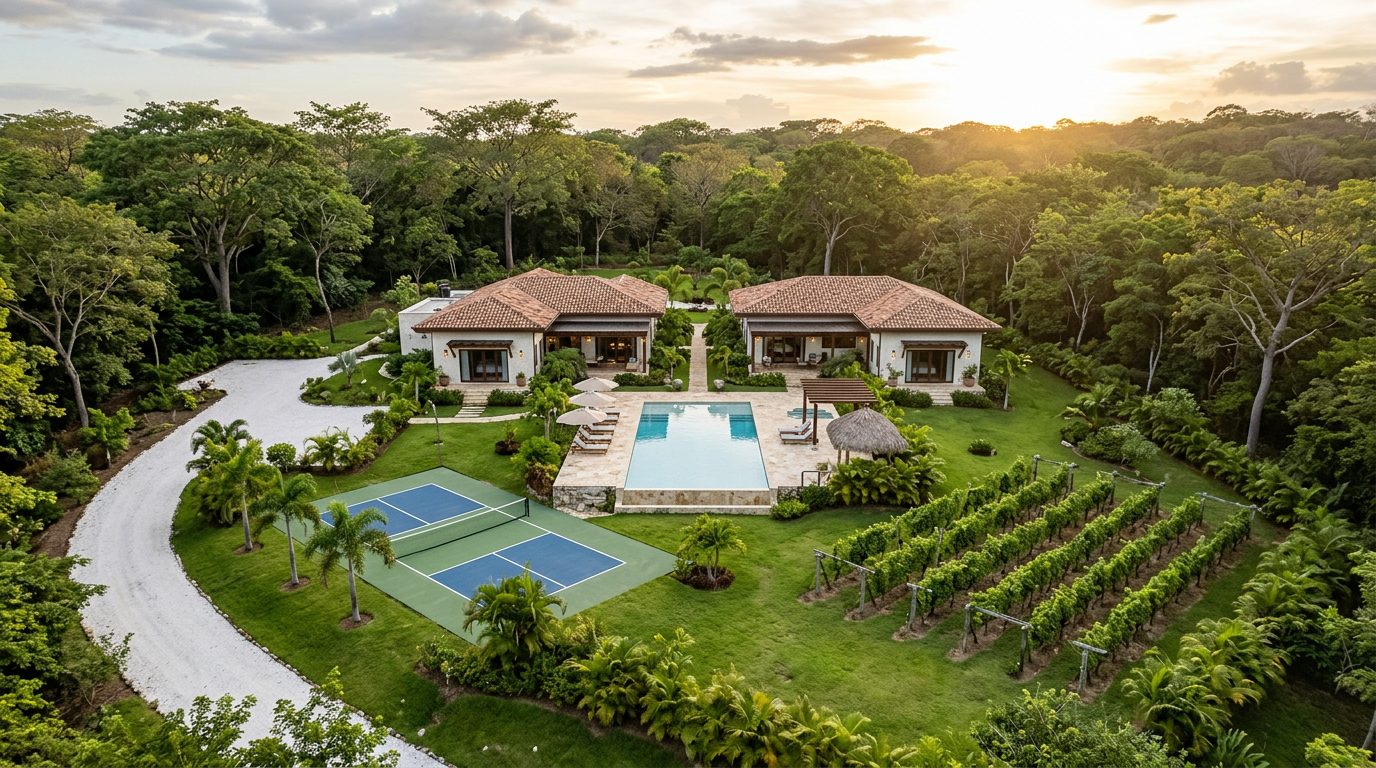
Concept render of two matching homes facing a central pool, with a pickleball court and a small vineyard

Two homes, one estate

The Twin Villas

Two 150 m² homes facing each other across a large pool, with a pickleball court and a small vineyard. Ideal for two families, or a home and a guest house.

  • Home one150 m²
  • Home two150 m²
  • Large pool and deck100 m²
  • Pickleball court, compact run-out120 m²
  • Small vineyardPermeable

520 m², more than the 500 m² allowed on a 5,000 m² lot. Fits Lots 4, 9, 10 and 11, which are over 5,200 m².

AI concept renderings for inspiration, not designs for a specific lot or photos of the property. Details in the images may differ from the size lists. Building sizes are examples. Your architect and the Municipality of Liberia confirm what can be built on each lot.

Field guide

Native trees of the Guanacaste dry forest.

Twelve trees that belong to this landscape. Some shade your house, some feed you, and some fence your land for free. Plant these first and the wildlife follows.

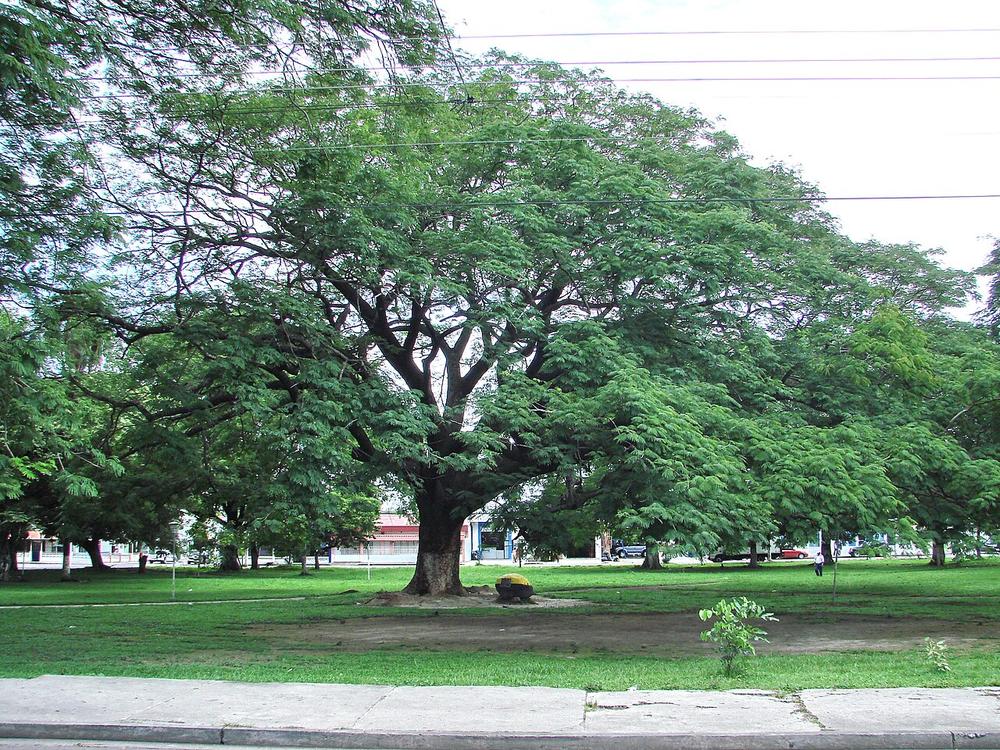
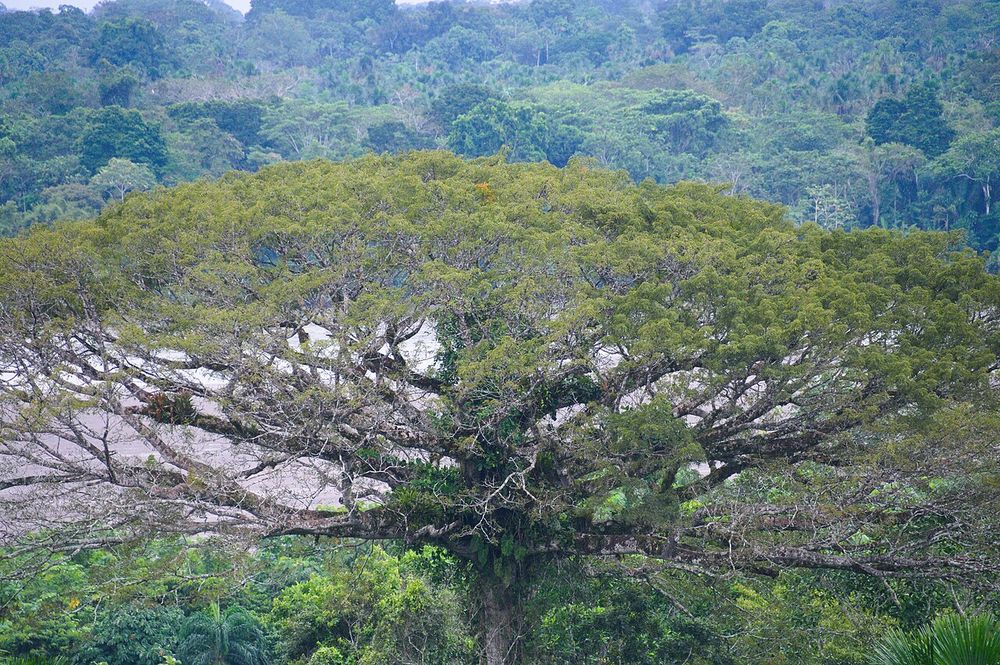
Guanacaste (Enterolobium cyclocarpum)

Guanacaste

Enterolobium cyclocarpum

Guanacaste tree (Elephant ear tree) · Fabaceae

About this tree
  • Costa Rica's national tree, prized in Guanacaste for the deep shade of its broad, spreading crown.
  • Briefly deciduous: most leaves drop in December and a fresh crown returns by April, along with white puffball flowers.
  • A nitrogen fixer that improves soil fertility, widely grown for shade and forage for cattle. Ear-shaped seed pods ripen around March.

Photo: Tizianok, CC BY-SA 3.0

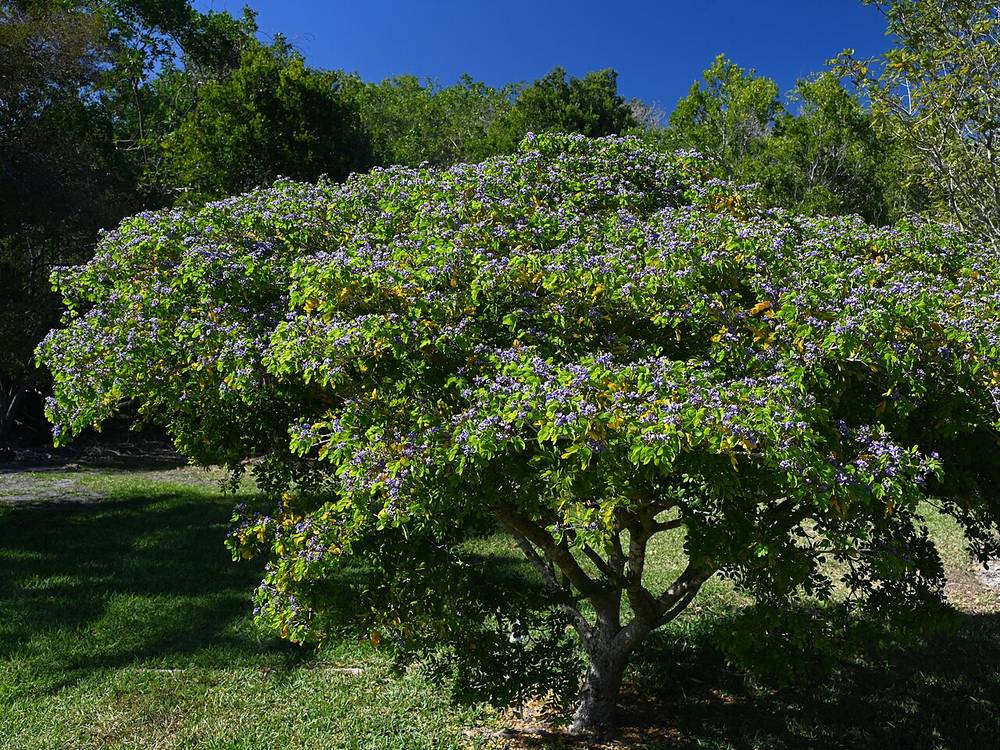
Guayacán real (Guaiacum sanctum)

Guayacán real

Guaiacum sanctum

Lignum vitae (Holywood) · Zygophyllaceae

About this tree
  • Slow-growing small tree (about 7 m) with purplish blue flowers; its wood is one of the hardest in the world.
  • Rated Near Threatened on the IUCN Red List; its tropical dry forest habitat is among the most threatened ecosystems.
  • Under a total logging ban (veda) in Costa Rica by Decree 25700-MINAE (1996).

Photo: Krzysztof Ziarnek, Kenraiz, CC BY-SA 4.0

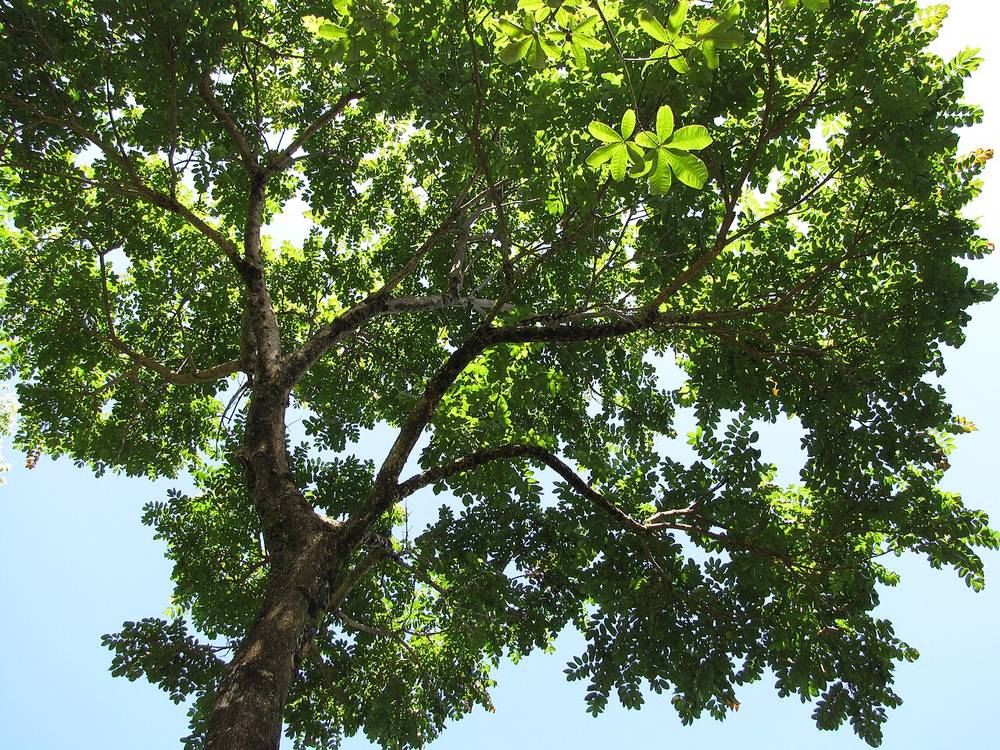
Cocobolo (Dalbergia retusa)

Cocobolo

Dalbergia retusa

Cocobolo rosewood · Fabaceae

About this tree
  • A tree of the dry forest, woodland and scrub of the Central American Pacific lowlands; deciduous and sun-loving, it regenerates well in clearings.
  • Source of the lustrous, dense, reddish cocobolo wood prized for furniture and musical instruments.
  • Listed as Critically Endangered on the IUCN Red List; CITES documents describe Costa Rican populations as almost completely exhausted.

Photo: Forest and Kim Starr, CC BY 3.0 us

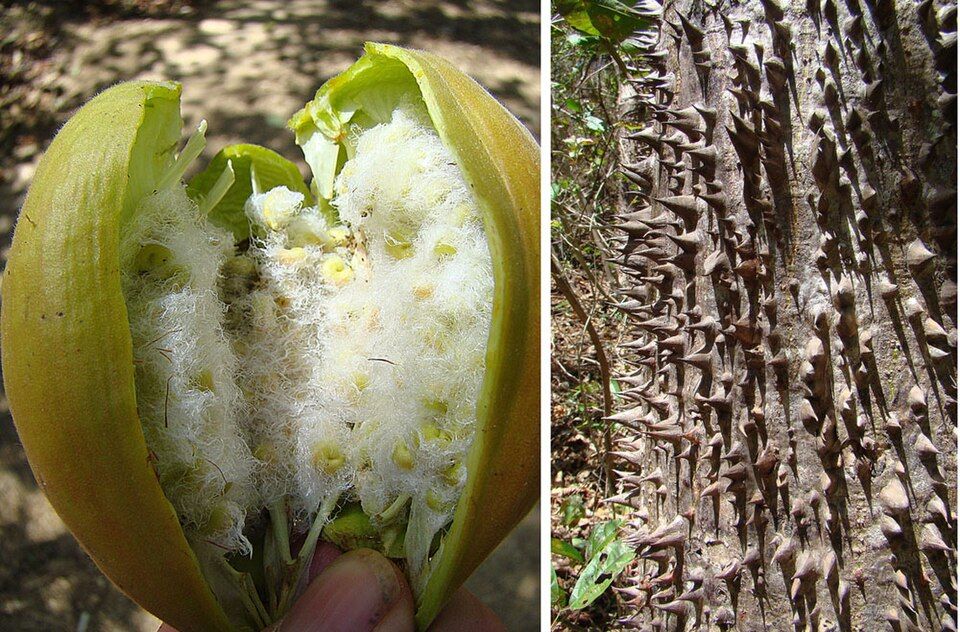
Pochote (Pachira quinata)

Pochote

Pachira quinata

Pochote (Spiny cedar) · Malvaceae

About this tree
  • Dry forest tree with large, stubby thorns on its trunk and branches; deciduous and able to reach 30 to 40 m.
  • Often planted as living fence posts; its stable, durable hardwood is used in construction and furniture.
  • Pollinated by bats and hawk moths, and parrots open the fruits to feed on the seeds.

Photo: Dick Culbert from Gibsons, B.C., Canada, CC BY 2.0

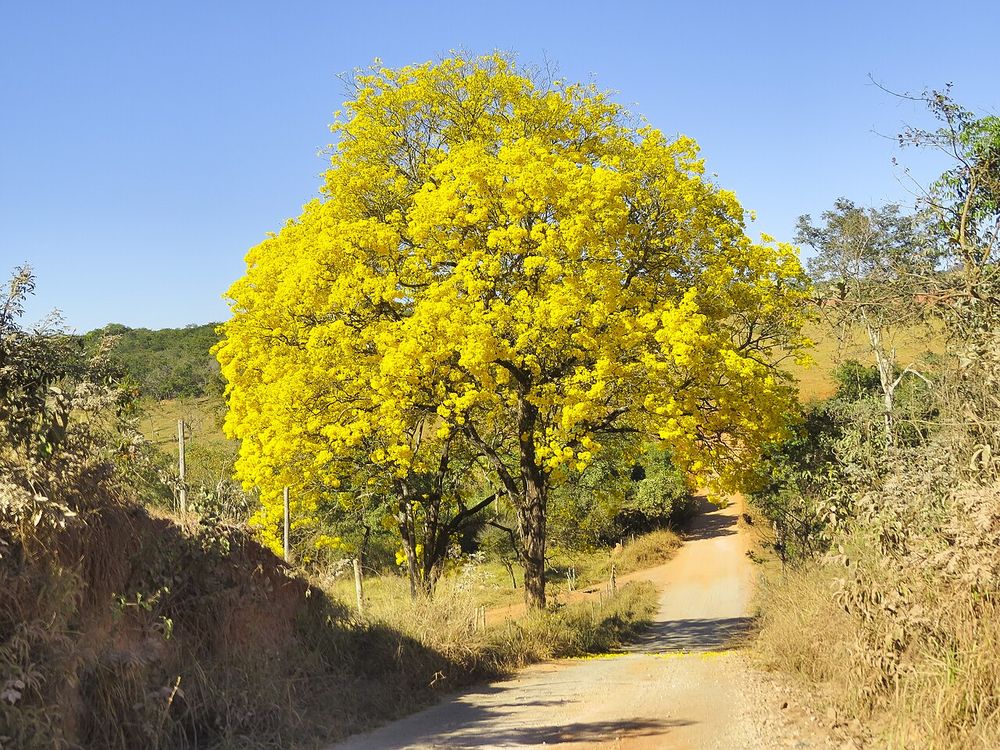
Corteza amarilla (Handroanthus ochraceus (syn. Tabebuia ochracea))

Corteza amarilla

Handroanthus ochraceus (syn. Tabebuia ochracea)

Yellow trumpet tree · Bignoniaceae

About this tree
  • Famous for mass flowering: large yellow flowers cover the trees in March and April, in synchronized displays lasting only 4 to 5 days.
  • Leafless through the dry season; found throughout Guanacaste from sea level to 1,000 m.
  • Exceptionally strong, durable wood. Bees visit the flowers and white-faced monkeys eat the developing fruits.

Photo: Welliton Fonseca, CC BY-SA 3.0

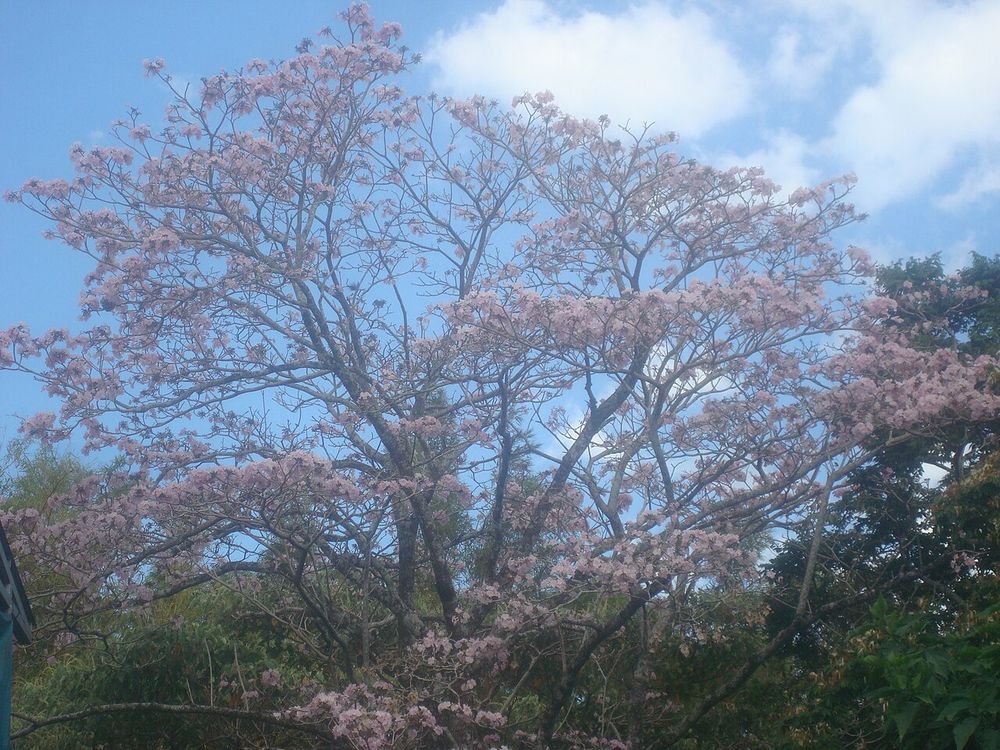
Roble de sabana (Tabebuia rosea)

Roble de sabana

Tabebuia rosea

Pink trumpet tree (Pink poui) · Bignoniaceae

About this tree
  • Pink to purple flowers cover the nearly leafless tree, mainly in January and February during the dry season.
  • Deciduous; gives shade in the rainy season, and its flowers draw hummingbirds, tanagers and orioles.
  • A fairly fast-growing tree whose seeds germinate very easily.

Photo: Rodtico21, CC BY-SA 4.0

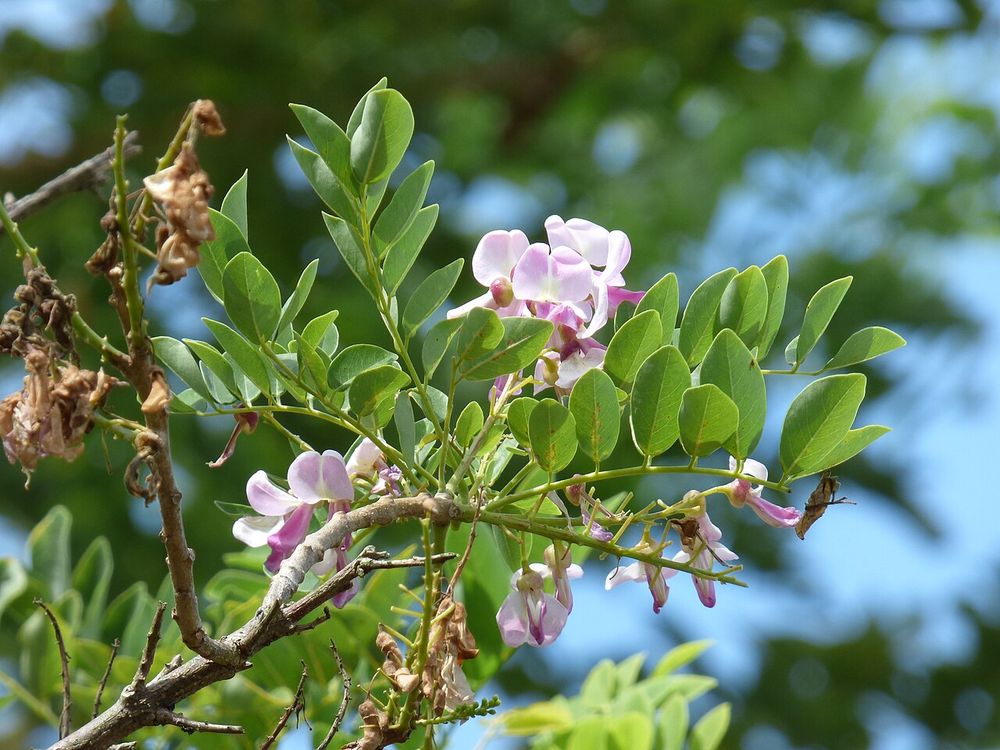
Madero negro (Gliricidia sepium)

Madero negro

Gliricidia sepium

Gliricidia (Quickstick) · Fabaceae

About this tree
  • Bright pink to lilac flowers appear on leafless branch tips; its true native range is the dry zones of southern Mexico and northern Central America.
  • A nitrogen-fixing legume widely used for live fencing, fodder, firewood and green manure.
  • Tolerates repeated cutting and coppicing, so it can be pruned every 2 to 4 months for forage.

Photo: Alejandro Bayer Tamayo from Armenia, Colombia, CC BY-SA 2.0

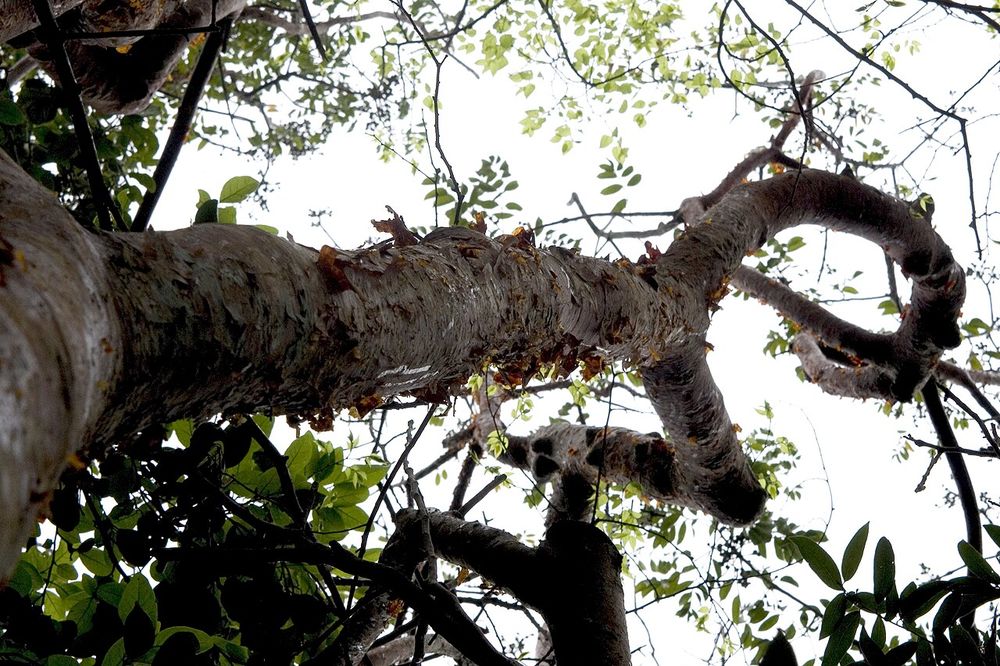
Indio desnudo (Bursera simaruba)

Indio desnudo

Bursera simaruba

Gumbo limbo (Naked Indian) · Burseraceae

About this tree
  • Instantly recognizable by its shiny, red, peeling bark; fast growing and semi-evergreen.
  • Branches stuck in the ground root readily, making it a classic live fence post and windbreak; one of the most wind-tolerant trees.
  • Birds seek out the red, lipid-rich coating on its seeds.

Photo: Everglades NPS from Homestead, Florida, United States, Public domain

Ceiba (Ceiba pentandra)

Ceiba

Ceiba pentandra

Kapok tree (Silk cotton tree) · Malvaceae

About this tree
  • A giant with buttress roots and a vast crown; briefly deciduous, it flowers while leafless.
  • Night-blooming flowers are pollinated mainly by bats and feed honey bees with nectar and pollen.
  • Its pods hold the cotton-like kapok fiber, and the tree is a sacred symbol in Maya mythology.

Photo: Mike Ostrowski, CC BY-SA 4.0

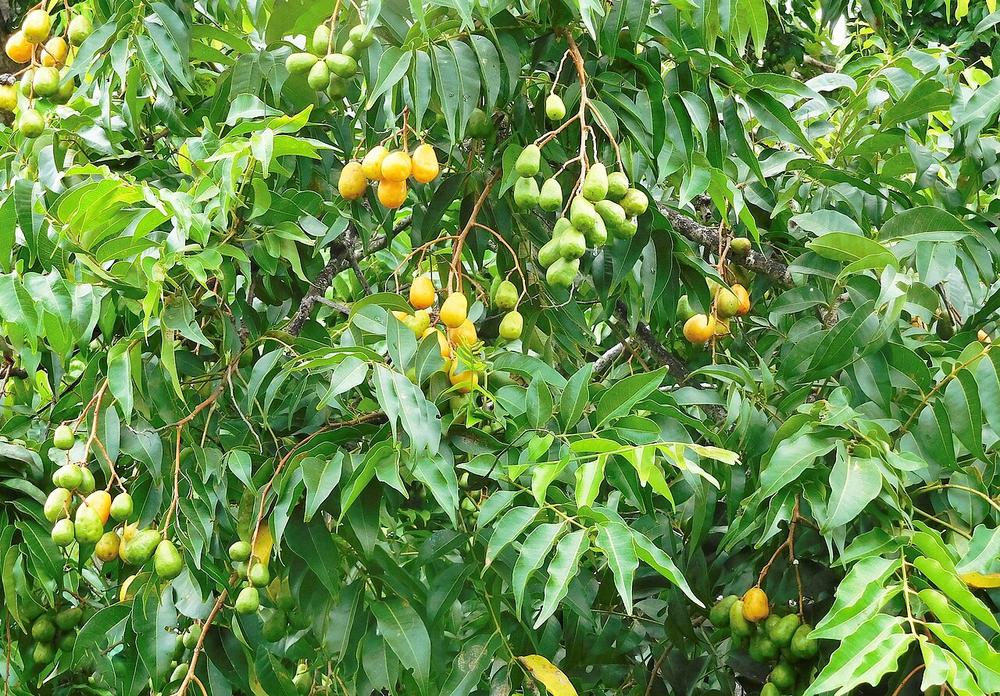
Jobo (Spondias mombin)

Jobo

Spondias mombin

Hog plum (Yellow mombin) · Anacardiaceae

About this tree
  • Deciduous tree up to 20 m with thick, corky, deeply fissured bark.
  • Small, sweet-scented white flowers (January to May) are followed by edible, tart yellow fruit (July to September) used fresh and for juice and jellies.
  • A member of the cashew and sumac family; its sap can cause an allergic reaction in sensitive people.

Photo: Filo gèn', CC BY-SA 4.0

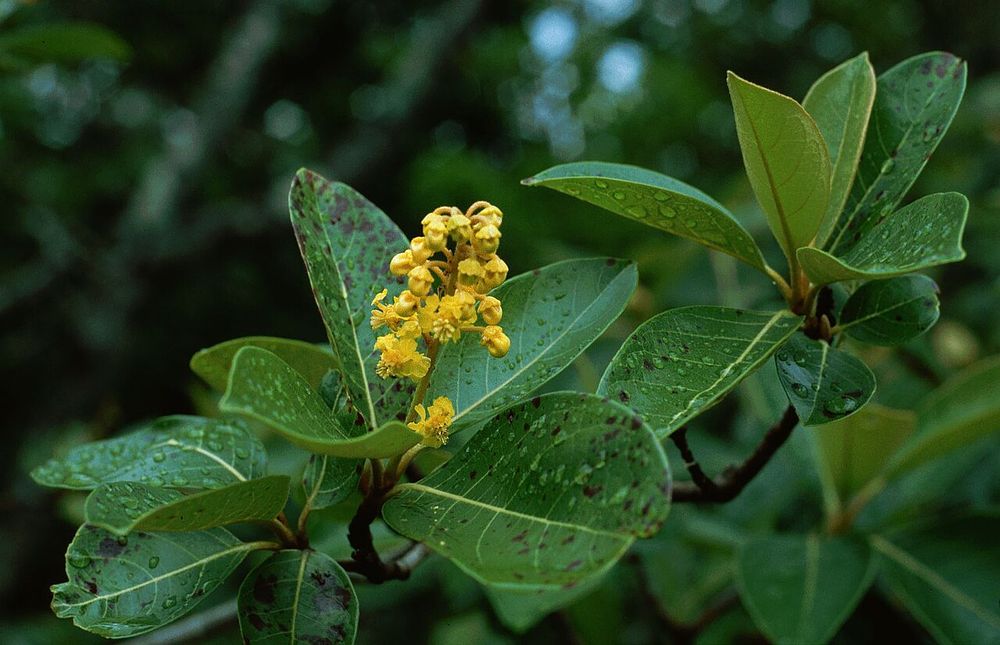
Nance (Byrsonima crassifolia)

Nance

Byrsonima crassifolia

Nance (Golden spoon) · Malpighiaceae

About this tree
  • Slow-growing large shrub or small tree up to 10 m, native and abundant in grassy savannas; highly drought tolerant.
  • Small, sweet, strongly scented yellow fruit used for desserts, juices and ice cream.
  • In Costa Rica the fruit is distilled into a rum-like liquor called crema de nance.

Photo: Franz Xaver, CC BY-SA 3.0

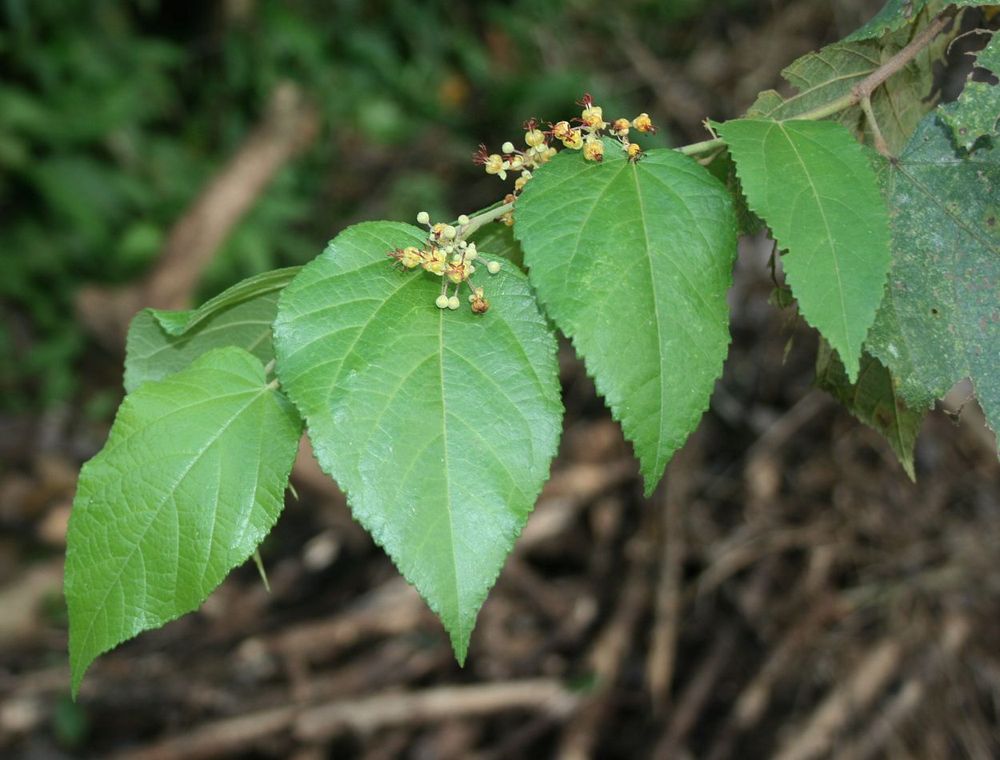
Guácimo (Guazuma ulmifolia)

Guácimo

Guazuma ulmifolia

West Indian elm · Malvaceae

About this tree
  • Medium-sized tree of pastures and disturbed forests; flowers through the year, especially April to October.
  • A vital fodder source for livestock toward the end of the dry season, and a shade tree in pastures.
  • Easy to propagate from seeds or cuttings; fresh seeds germinate in 7 to 14 days.

Photo: Franz Xaver, CC BY-SA 3.0

Reference photos of each species from Wikimedia Commons, not photos of the property. Facts from Wikipedia, the Área de Conservación Guanacaste and CITES.

Homestead ideas

Live lightly on 5,000 m².

With 90% of each lot left as open ground, there is room for a real homestead. A few ideas that suit this climate.

  • Harvest the rain

    Guanacaste has a long dry season. Roof gutters feeding a cistern let you bank rainy-season water for the garden in the dry months.

  • Run on the sun

    Costa Rica allows homes to generate their own solar power and connect to the grid. A solar carport or barn roof counts toward coverage you are already using.

  • Fence with living trees

    Madero negro, pochote and indio desnudo grow from cut posts. A living fence gives shade, fodder and a wildlife corridor instead of rusting wire.

  • Plant a food forest

    Layer native fruit like nance and jobo with mango, citrus and plantain, then herbs and ground cover underneath. It feeds you and shades the soil.

  • Keep native bees

    Costa Rica has native stingless bees that are gentle to keep and pollinate the garden. A few boxes under the eaves is a good first project.

  • Close the loop

    Compost kitchen scraps, send filtered shower and sink water to fruit trees, and mulch heavily. Every liter kept in the soil matters in April.

Planned for owners

Shared spaces for a growing community.

Beyond each private lot, La Arboleda plans a few shared things that make homesteading easier together.

  • Shared owners' orchard

    A common orchard of native and tropical fruit trees that every owner can harvest from, planted and cared for together.

  • Seed library

    A shared collection of seeds and cuttings from the property, so owners can swap what grows well here and start new plants for free.

  • Owners' tool shed and workshop

    Shared larger tools, a workbench and storage, so each lot does not need its own of everything.

  • Native reforestation along the creek

    The protected strip along the quebrada is replanted with native dry forest trees to shade the water, hold the banks and link habitat for wildlife.

Planned amenities. Final design, location and timing to be confirmed.

Growing year

A planting calendar for the dry forest.

Guanacaste has two seasons: a long dry season, usually December to April, and a rainy season from about May to November. Timing is everything here.

  1. JanDry

    Dry season. Water young trees deeply, mulch thick, harvest. Roble de sabana flowers.

  2. FebDry

    Dry season. Prune fruit trees, collect seeds, plan the rainy-season garden.

  3. MarDry

    Hottest and driest. Protect soil with mulch. Corteza amarilla blooms. Clean gutters and tanks.

  4. AprDry

    Late dry season. Prepare beds and planting holes, start seedlings in shade, check cisterns.

  5. MayRainy

    Rains usually begin. Plant trees, living fence posts and the main garden once the soil is moist.

  6. JunRainy

    Rainy season. Keep planting trees and cover crops. Rain tanks fill.

  7. JulRainy

    Veranillo de San Juan, a short drier spell, is common. Water new plantings if it runs long.

  8. AugRainy

    Rains return. Second planting of beans, squash and greens.

  9. SepRainy

    Often the wettest stretch. Watch drainage and erosion on slopes and along the creek.

  10. OctRainy

    Heavy rains. Last good window to plant trees so roots settle before the dry season.

  11. NovTransition

    Rains taper off. Harvest, mulch and top up water storage before the dry months.

  12. DecDry

    Winds pick up and the dry season starts. Guanacaste trees drop their leaves. Switch on drip irrigation.

A general guide. Seasons shift from year to year, so plant by the rain, not the date.

New owners

Your first 90 days on the land.

A simple plan for the first three months after you buy, so you start building and planting in the right order.

Days 1 to 30

Get to know the land

  1. Walk the lot with us and the survey. Find the corners, the road frontage and the creek setback if your lot has one.
  2. Mark the Guayacán Real, cocobolo and other big trees you want to keep, and note where the open ground is.
  3. Confirm your water and electricity connection points.
  4. Watch the land at different times of day: sun, shade, wind and where water runs when it rains.

Days 31 to 60

Plan what you will build

  1. Choose an architect or engineer registered with the CFIA. Plans need their stamp for a municipal construction permit.
  2. Sketch your 10%: home, greenhouse, sheds, pool and paved areas together must stay inside the coverage limit.
  3. Start a small nursery with seeds and cuttings from the property, and plant a living fence line.
  4. Get quotes for solar, a rain cistern and fencing.

Days 61 to 90

Start the homestead

  1. Submit your plans to the Municipality of Liberia for the construction permit.
  2. Set up rainwater storage before the rainy season so the first rains are not wasted.
  3. Plant trees and your first garden beds as the rains arrive, usually around May.
  4. Start a compost pile and introduce yourself to your neighbours. The seed library is a good place to begin.

General guidance, not legal advice. Your attorney, architect and the municipality confirm the steps for your purchase and design.

Location

Volcano country, close to the city and the airport.

Curubandé sits on the road from Liberia toward Rincón de la Vieja National Park, in the cooler, greener foothills of Guanacaste. You are close to Liberia's shops and services and to Daniel Oduber Quirós International Airport, with the beaches of the Gold Coast within reach for a day out.

  • LiberiaGuanacaste's capital, services and hospitals
  • Liberia International Airport (LIR)Direct flights to the US and Canada
  • Rincón de la Vieja National ParkVolcano trails, hot springs and waterfalls
  • Poza Los CoyotesBlue-green river pools fed from the slopes of Rincón de la Vieja
  • Gold Coast beachesPlayas del Coco, Ocotal and beyond

Questions

Before you visit.

How big are the lots?

Fifteen of the seventeen lots are between 5,001 and 5,112 m² (about 1.24 to 1.26 acres). Lot 9 is 5,343 m² (1.32 acres) and Lot 4, the largest, is 6,435 m² (1.59 acres). Every area comes from the registered survey.

How much can I build?

Impermeable coverage, meaning roofs, patios and paved surfaces, is limited to 10% of each lot. On a 5,000 m² lot that is about 500 m². Your architect and the municipality confirm the details for your design.

Are water and electricity in place?

Yes. Water and electricity are available to the project. Ask us for the details on connection for the lot you are interested in.

Can I cut the trees?

Guayacán Real and cocobolo are protected species in Costa Rica and are not cut. Homes are placed to work around them. We can walk each lot with you so you can see where the open ground is.

Can foreigners buy property in Costa Rica?

Yes. Foreigners can own titled property in Costa Rica with the same rights as citizens. We recommend working with an independent Costa Rican attorney for the title study and closing.

How do I see the lots?

Send an inquiry below and our team will set up a visit. We are based in Playas del Coco, Guanacaste.

Inquire

Ask about a lot and book a visit.

Tell us which lot caught your eye. We reply by email or WhatsApp, whichever you prefer.

Exclusively represented by

Real estate sales and vacation rental management in Playas del Coco, Ocotal and the Guanacaste Gold Coast. We live here. We manage here.